
Beyond the Surface
On entanglements between humans and more-than-human life, interrogating systems of extraction, ecological harm, and social injustice while envisioning collective, decolonial, and multispecies practice
In the Issues publication of SoC titled “Making Public” (2021), one entry stood out quite strikingly to readers from subsequent cohorts. The piece, titled “Talk without a tongue—A glossary to redefine your thinking,” left a lasting impression. While we invite you to read the full entry, we can begin this long read with an excerpt from the aforementioned contribution:
“This is a refusal. A Refusal to theorize, to put into academic words, to reference human scholars.
Instead we want you to.
Think about who you recognize as kin.
Does thinking involve a brain?
What about all those who take decisions without a brain? Is it still called a decision then?
Does every organism feel pain?”
The contribution is submitted by the Other Than Human Entity—they passed through institutions in the fields of geospheric and cosmic sciences and after our vanishing, the Entity will still be simultaneously teaching and acquiring knowledge.
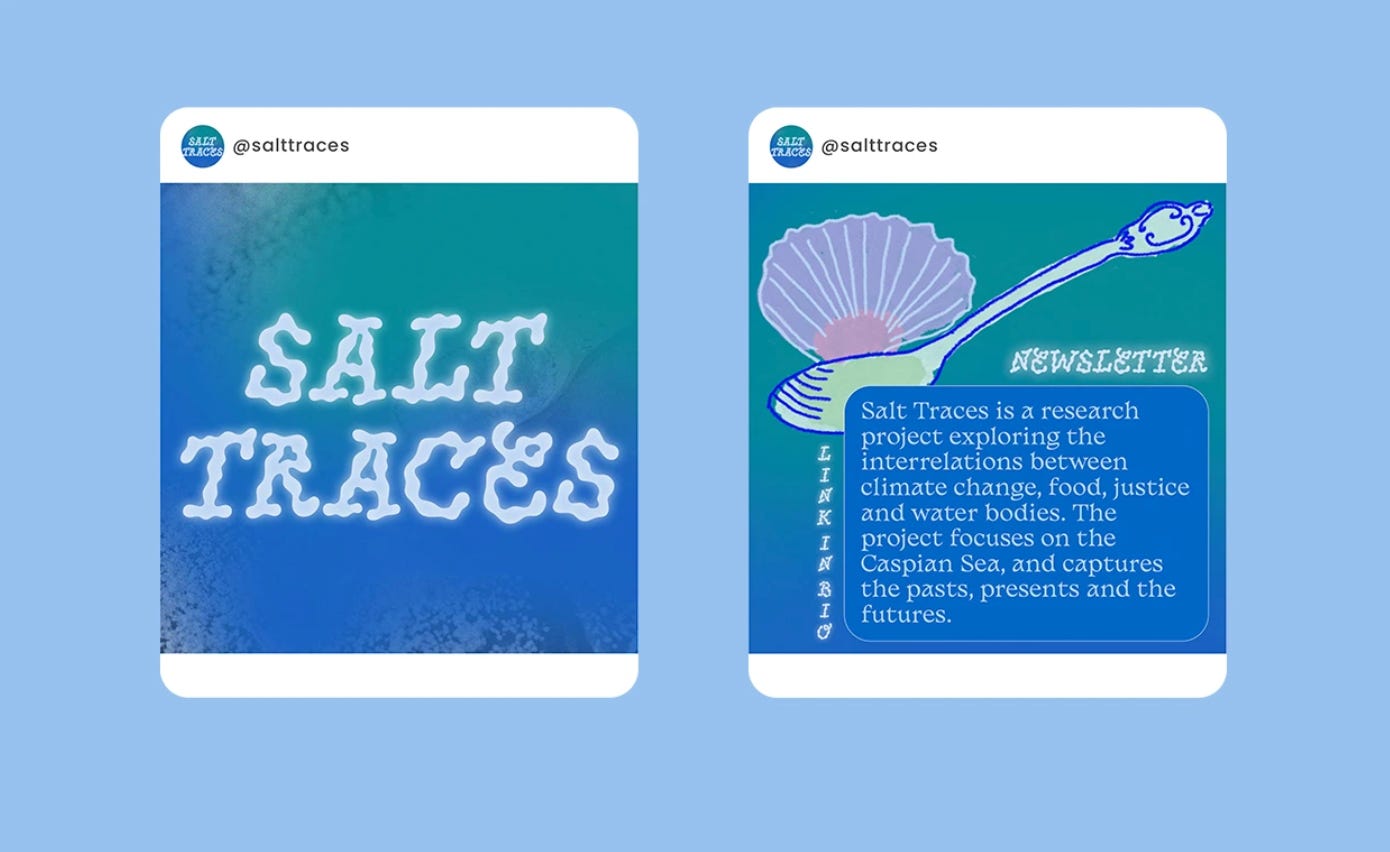
In the same year that “Talk without a tongue—A glossary to redefine your thinking” was published, the SoC cohort provided space and time for research by Muj Abdulzade, as part of the Participating the Participatory lab. Together with Aysel Akhundova, Ilaha Abasli, and Nazaket Azimli, Muj co-founded the collective Salt Traces, which explores the interrelations between humans and more-than-humans. Emerging from a region embracing the Caspian Sea—the largest landlocked body of water on the planet—Salt Traces investigates the connections and traces between water bodies, food, and communities against the backdrop of climate change. To make their research public and to foster dialogue, the collective launched a monthly newsletter. .
Indeed, the question—while poetically posed and presented—points to a critical aspect of understanding the commons: namely, whom we consider when working toward creating economies, infrastructures, and systems centered around commoning. Many of us—researchers, artists, and social and climate justice activists—advocate, demand, and work toward sharing resources and driving social and political change to meet the needs of bodies marginalized by dominant groups. Yet, as “Talk without a tongue” reminds us, we often forget to ask: who do we recognize as kin?
Building on the premise set forth by the Other Than Human Entity and on Salt Traces’ research around the Caspian Sea, the recent work by the collective de_colonial language and Irina Denkmann extends this inquiry further. For the exhibition and accompanying series of circulation events titled TAKE aSEAT. MAKE aSHIFT., the group invited Lena Pozdnyakova and Eldar Tagi to contribute their work and research on non-human animals, expanding the conversation on interspecies relations and shared epistemologies.
The exhibition brings together a series of projects that confront the discrepancy between words and deeds, the dysfunction of institutional representation, and the shortcomings of knowledge production. Throughout this series of circulation events, the logic of taking a SEAT has evolved—from an initial search for a place to exist, toward a reflection on the act of occupying space itself. Sitting together, claiming the right to write one’s own story, and practicing radical collectivity now converge on the same page.
Lena Pozdnyakova and Eldar Tagi presented a sound performance and an art installation addressing the condition of marginalized bodies—specifically, the bodies of animals subjected to extraction in the Central Asian region.
The work, titled Beyond the Surface and Into the Depth, situates the story of the Caspian Sea within broader questions of survival, exploitation, and ecological collapse. It begins with endangered species—most notably the sturgeon, long targeted for caviar—and extends to seals and other marine life caught as bycatch or drawn into illegal trade. Local communities face mounting pressures: conservationists warn of impending ecological disaster, the state remains largely inactive, and people lacking alternative livelihoods are often driven into practices that further exacerbate environmental harm. Research by Dmitrieva et al. (2013) and Svolkinas et al. (2023), along with consultations from experts such as Assel Baimukanova, Linas Svolkinas and Dr. Simon Goodman, illuminates how these socio-political and ecological conditions intertwine, forming a cycle of degradation that impacts both animals and humans. The installation translates these realities into spatial experience—through hanging and floor-based works connected by visual “streams” that trace the layered entanglements of ecological devastation, human survival, and systemic neglect.


At the same time, the project broadens its lens to interrogate the deeper cultural and political histories entwined with black caviar, marine sentience, and imperial extraction in Central Asia. It seeks to reclaim ecological memory and to reimagine multispecies futures beyond domination—asking what it means to decolonize not only land and history, but also water, bodies, and the systems of knowledge that define whose lives are valued. Beyond documenting ecological collapse, the artists propose new practices of coexistence with non-human animals: questioning the violence of consumption, challenging the extractive economies of caviar, and learning through feminist and more-than-human perspectives. Participants are invited to engage with the world through non-cruel alternatives—tasting and sharing them collectively. In doing so, the project directly addresses speciesism, calling on audiences far beyond the Caspian context to recognize animal sentience, confront the injustices at stake, and consider their own responsibility and capacity for action.
To further expand on the topic of animal sentience and situate it within the broader socio-political discourse of extraction and exploitation, Lena Pozdnyakova organized a presentation supported by the New Roots Institute—an organization dedicated to empowering the next generation to end factory farming. In her talk, informed by New Roots Institute’s work and Fish Welfare Initiative’s research, she addressed the harms of factory-farming-based food systems and the intertwined suffering of both animals and humans. Focusing specifically on fishing practices, Pozdnyakova examined the multiple forms of damage these cause to marine habitats, biodiversity, and planetary health—highlighting issues such as bottom trawling, which releases carbon and exacerbates global warming, and the cascading effects of industrial fishing on communities directly and indirectly affected by ecological devastation.
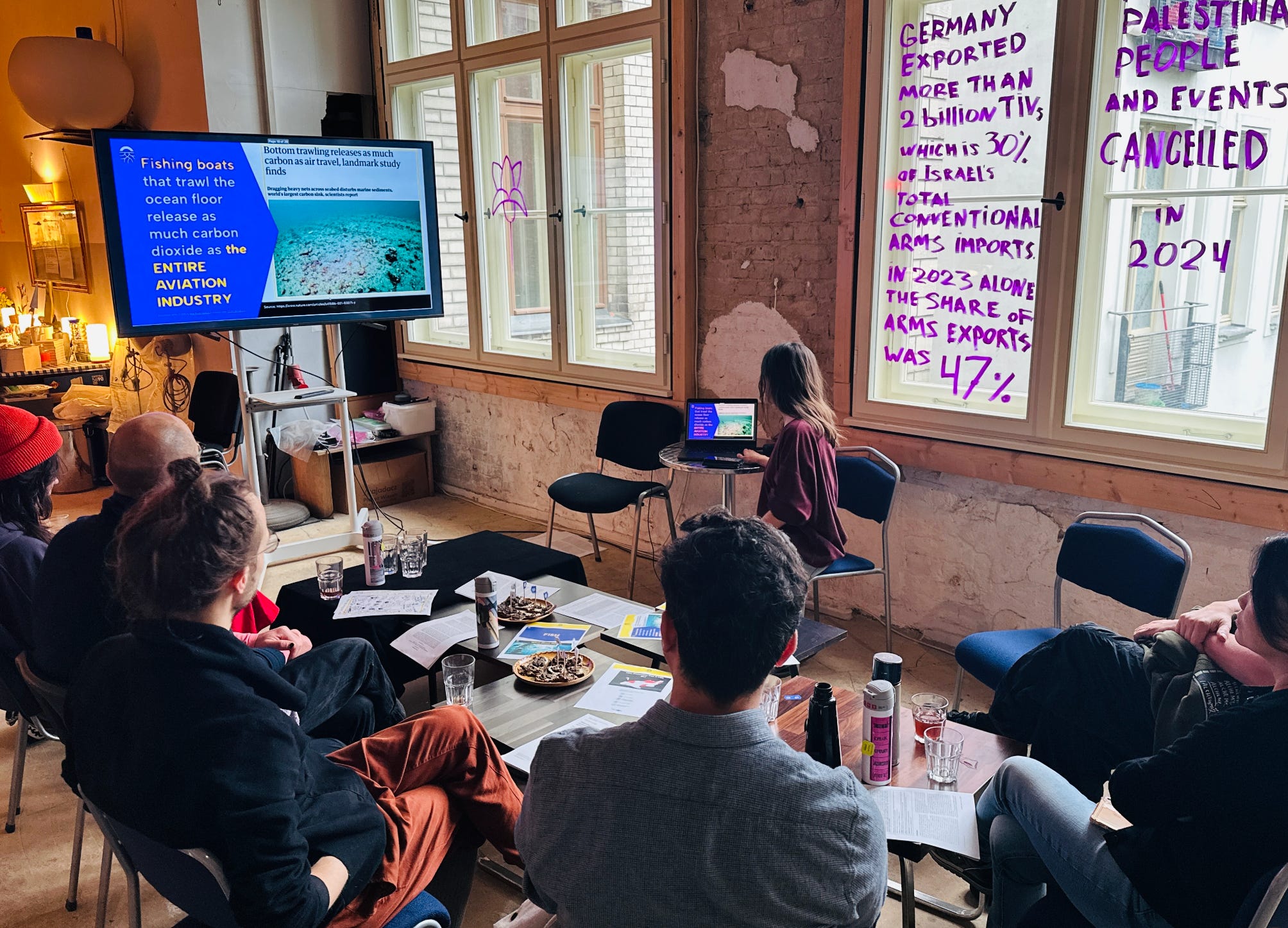
Informed by Ryuji Chua’s activist and educational work, the presentation also engaged with current scientific research demonstrating that fish feel pain, revealing the extreme levels of suffering endured within contemporary food systems.
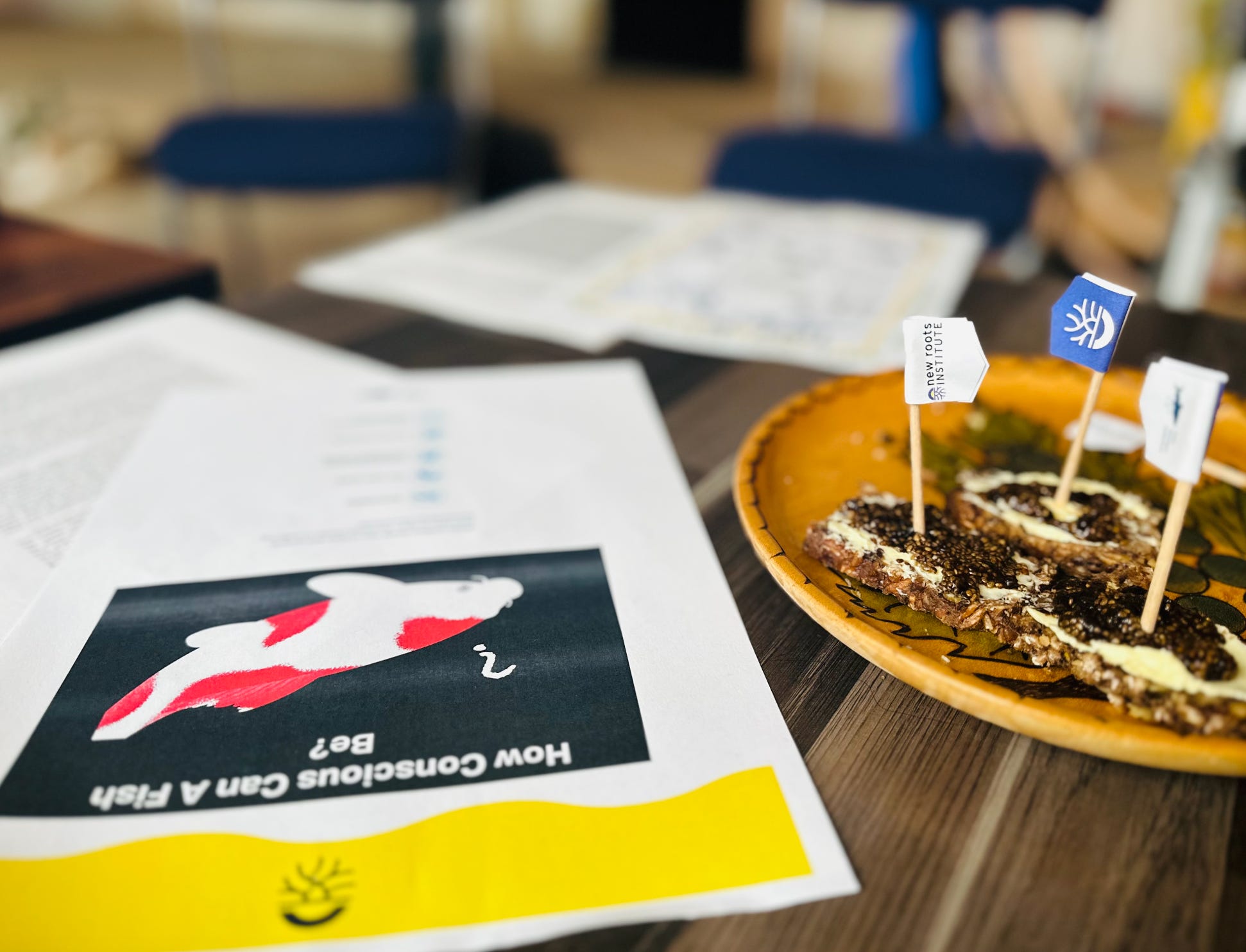
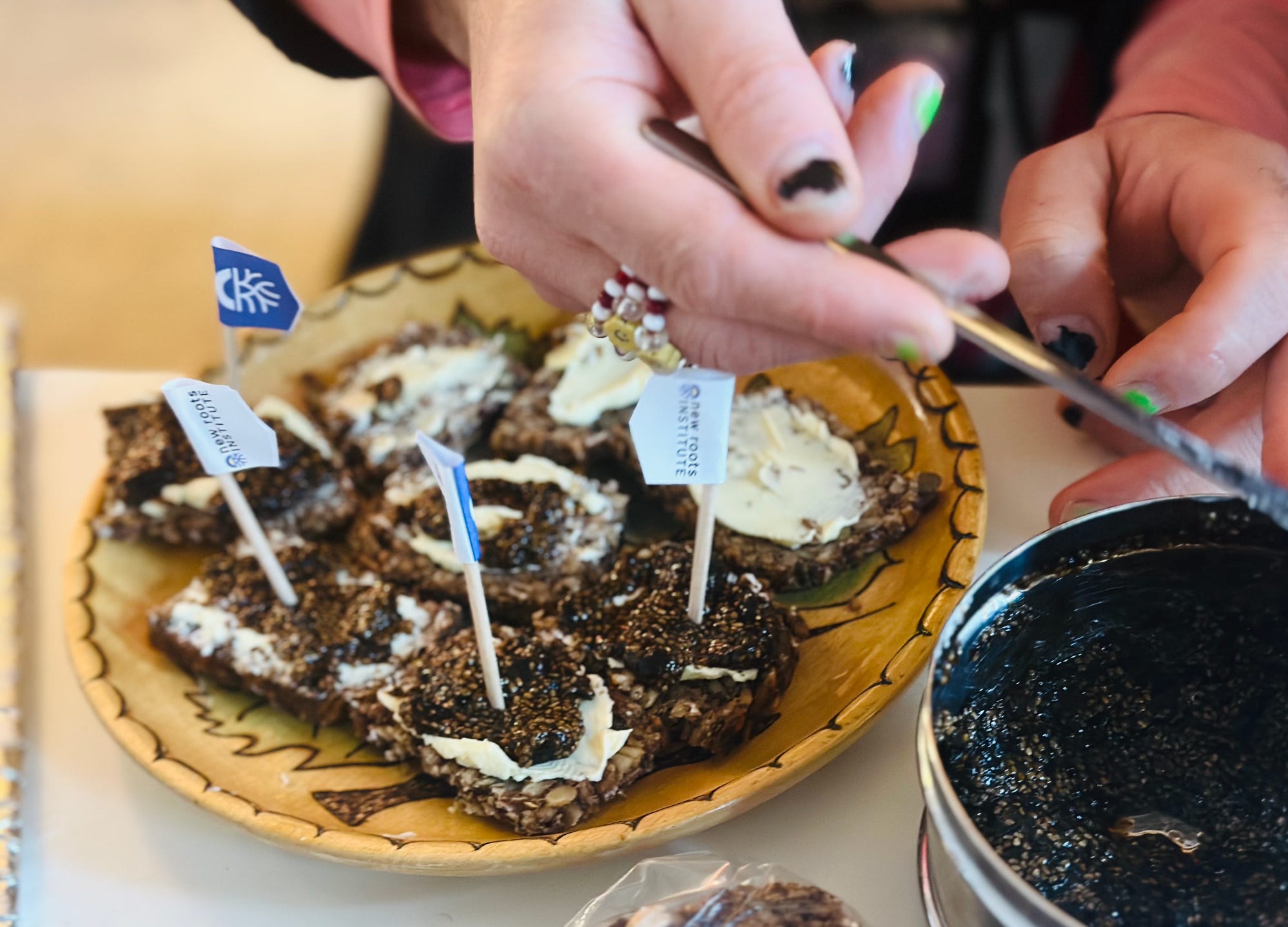
The atmosphere lightened during the subsequent phase of cruelty-free caviar preparation, as participants were invited to share a recipe and taste small servings of plant-based caviar on toast, prepared by the artist. Entering the conversation through the senses—through taste—combined with the earlier presentation supported by scientific research on sentience and suffering, seemed to forge a visceral connection between the damage inflicted upon animals and its broader consequences for human lives. Much like the artist’s textile installation, the event wove together a network of threads that made tangible the entangled realities of human–animal relationships and the shared vulnerabilities they expose.
As the curators of the exhibition TAKE aSEAT. MAKE aSHIFT. of the show posit:
“In these ruins remained questions, disappointments, strategy changes, and completely wonderful tactics of collectivity. While institutions of various sizes measure themselves against their level of (un)entanglement in wars and war crimes, grassroots collectives engage in anti-war imagination, practices of resistance, and alternative ways of life beyond media-fabricated ‘truth.’ Between the dystopian reality of institutions and the absent utopia, there is a space for mutual care and collective practices. If ‘reality’ is occupied by colonial and capitalist fantasies, then the space of collectivity we are talking about is not reality—it is life itself.”
In response to this statement, the work of artists engaging with more-than-human and non-human forms of life offers us an opportunity to reflect on the very nature of our entanglements and invites us to ask: “Who are we, wherever we are, harming now?” Where, personally, do we stop in order to reduce the violence perpetuated in the world? And how far do we have to go in order to see the violence over other bodies?
As a backdrop to the workshop and presentation, SoC alumni and Studio106LA’s virtual exhibition space presented its third quarterly awareness show at the end of summer. The exhibition focused on themes explored by many working with the commons: the connections between culture and nature, an ecological lens on decoloniality, and the entanglement of human and non-human forms of life within complex socio-political contexts. It also examined the role of communication, pedagogy, and the arts in raising awareness, inspiring change, and motivating action.
As we announced earlier, you can explore it here.
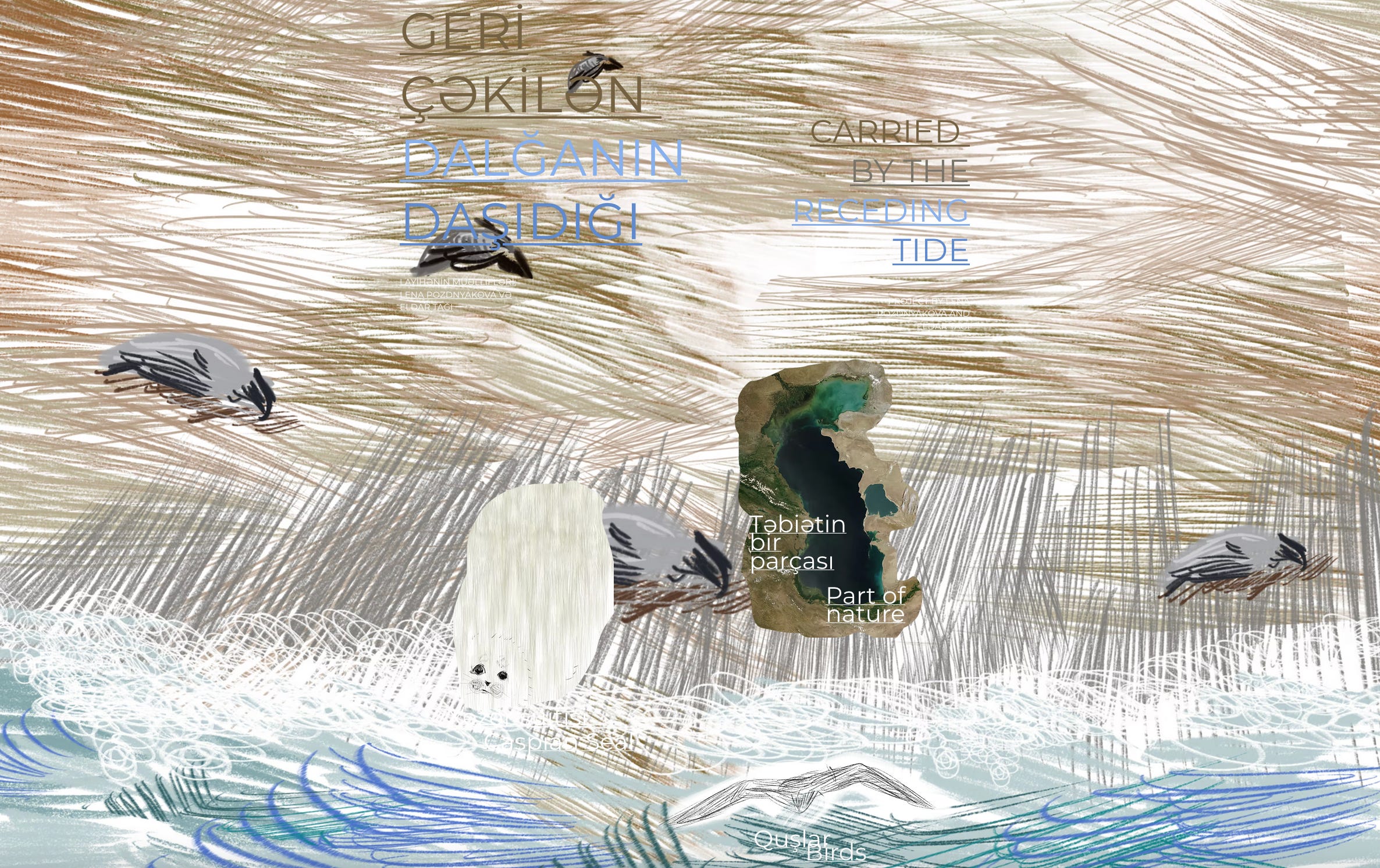
And if you are interested in diving deeper into the themes of decolonial thinking, explore stories from the region, de_colonialanguage collective and Irina Denkmann are inviting you to a closing of the program this week.
18 October, Saturday
17:00 closing ceremony
18:30 poetry readings with Vica Kravtsova and Marina Solntseva
20:30 performance by Kreolex zentre
Kreolex zentre is a paranormal organisation represented by the two of its employees — Maria Vilkovisky and Ruthia Jenrbekova.
On Saturday night, October 18, they will appear at the at the TAKE aSEAT. MAKE aSHIFT Closing Ceremony to read a couple of poems and sing a few songs from their performance “Tribute to the Unknown”, commissioned by the steirischer herbst (2025). (duration - 45 min)
Where? Kulturfabrik Moabit, Lehrter Str. 35, 10557 Berlin
Media who wrote about the show:
Berliner Gazette:
“After all, while most social actors measure themselves by their level of involvement in wars, grassroots collectives engage in antiwar imagination and resistance, exploring alternative ways of life. The exhibition project “TAKE aSEAT. MAKE aSHIFT,” demonstrates this possibility.”
You can read about the issues raised at this exhibition here in English: “Take a and here in German ‘Freie Platzwahl für alle? Wie migrantisierte Künstler*innen in einem Nationalstaat ihren Platz finden’ .
Deutsche Welle:
“Imaginary Chuvashia, a dictionary compiled by a grandmother from Kazakhstan, research on the Caspian Sea, and a box of artefacts from Azerbaijan”
Here artists Victoria Shaltar, Nazira Sadvakasova, Nilüfer Musaeva, and Lena Pozdnyakova gave an interview to Deutsche Welle (article in Russian).
We, at SoC, will certainly continue the conversation on decolonial movements, social justice practices with our Alumn* network, and will continue the work of imagining and creating a more inclusive, fair, and just world for all.
Stay tuned for future newsletters!
Yours,
SoC Alumni